
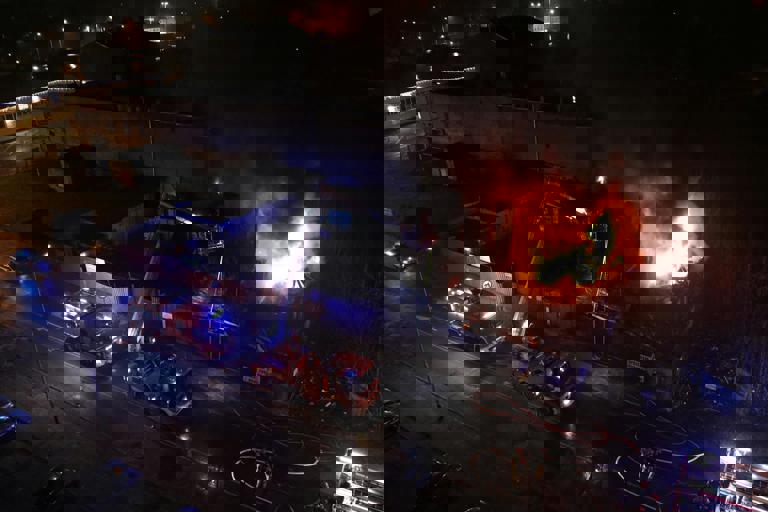
A major warehouse fire erupted in the downtown core late Tuesday evening, sending thick plumes of smoke into the air and prompting a significant emergency response. Firefighters rushed to the scene with trucks, hoses, and specialized gear, racing against time to contain the rapidly spreading flames. However, as crews coordinated their efforts, an unexpected hazard emerged overhead: an unauthorized drone hovering directly in their flight path.
The rogue drone appeared shortly after firefighters deployed, drawing immediate concern among emergency personnel. Deputy Fire Chief Lisa Morin commented, “We spotted the drone above the warehouse while aerial units were preparing to make water drops. Its presence forced us to halt those operations temporarily for safety reasons.” The interruption put additional strain on firefighters already battling strenuous conditions.
Fire officials explained that drones pose serious risks during emergency operations. Unmanned aerial vehicles can interfere with the trajectory of water streams, obscure visibility, and, most dangerously, collide with helicopters or other aerial support. Morin added, “Any foreign object in our airspace—particularly one we haven’t coordinated with—can quickly escalate into a tragic accident or delay essential tasks.”
Emergency crews are trained for multiple contingencies, but managing an active drone in a crisis situation presents unique challenges. As the situation at the warehouse grew more acute, firefighters were forced to temporarily withdraw certain resources, including aerial ladders and support teams. This pause allowed officers to locate the drone operator and consult with police on how best to neutralize the risk without further delaying firefighting efforts.
According to witnesses gathered nearby, the drone hovered at an altitude close to that of the fire trucks’ extended hoses. Jennifer Smith, a bystander who observed the incident, said, “We saw the drone swoop in and stay right above the flames. It was pretty obvious it didn’t belong there, and you could feel the tension among the firefighters.” The crowd was moved to safer distances as a precaution.
Law enforcement officers responded by attempting to track down the individual piloting the drone. Detective Marcus Caldwell of the city’s police service described the protocol: “Unauthorized drone operation in active emergency zones is strictly prohibited by Transport Canada regulations. Our officers canvassed the surrounding area, interviewing witnesses and trying to pinpoint the location of the controller.” The operator, however, managed to leave before police could intervene.
Transport Canada officials confirmed that flying drones within controlled airspace during an emergency is a federal offence, potentially carrying hefty fines or criminal charges. A spokesperson emphasized, “These laws exist to ensure the safety of both first responders and the public. We are investigating this incident closely, and anyone with information should contact local authorities immediately.”
Despite the interruption, fire crews were eventually able to regain momentum after the drone’s disappearance. The blaze, which took several hours to bring under control, resulted in the partial collapse of the warehouse roof but remarkably did not cause any major injuries. Chief Morin credited the resilience and adaptability of her team for preventing a more severe outcome. “Even with the setbacks, our crews worked tirelessly,” she said.
The warehouse, previously used for storage of commercial goods, suffered extensive fire and smoke damage. Business owners affected by the blaze are now assessing losses and working with insurers to determine next steps. Paul Anders, whose company stored supplies in the building, expressed frustration, “It’s hard enough dealing with a fire—knowing someone’s drone may have slowed down help makes it feel even worse.”
Community leaders have since called for increased education around drone safety and stricter enforcement of existing regulations. City Councillor Anita Cho stated, “We need to remind residents that emergencies are not spectacles. Drones, while useful for hobbyists or professional videographers, must never endanger the livelihoods or lives of others.” She advocated for more visible signage at known hotspots around the city.
This incident is just the latest in a national trend of drones interfering with emergency responses. The Canadian Association of Fire Chiefs recently reported at least 17 similar cases across the country in the past year alone. Experts warn that as the popularity of consumer drones rises, so too does the risk of unlawful interference with critical public safety operations.
In the wake of the downtown warehouse fire, officials vow to pursue the drone operator and use the case as a learning tool. Chief Morin summarized the broader lesson: “Drones are powerful technology, but with power comes responsibility. We urge everyone to review the rules—and above all, respect the safety of our emergency responders.” The hope is that a proactive approach will prevent further incidents and keep city residents out of harm’s way.