
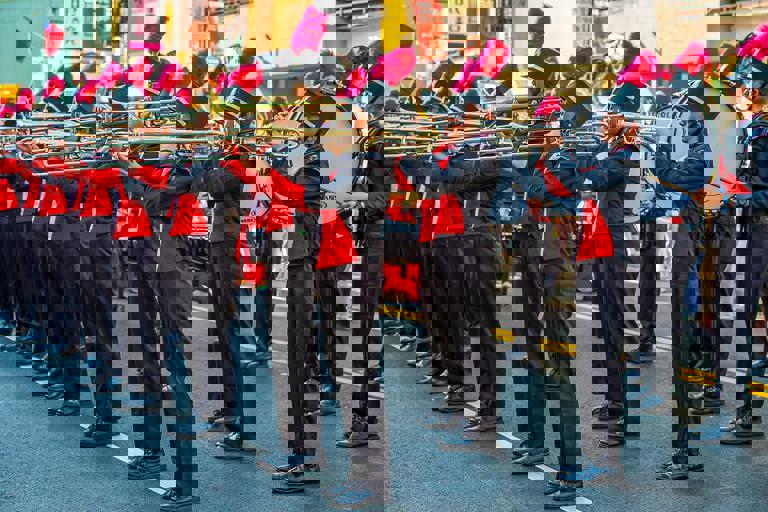
Commuters heading through a busy downtown transit hub yesterday morning were treated to a surprise when a flash mob orchestra materialized amongst the rush-hour crowds. Just past 8:00 a.m., as hurried travelers made their way towards trains and buses, the quiet murmur of the terminal was suddenly transformed by the swelling sound of live classical music. Many travelers stopped in their tracks, stunned and amused by the spontaneous transformation of their morning routines.
The performance began subtly, with a single violinist unassumingly unpacking her instrument near a ticket kiosk. As she played the opening bars of Beethoven’s "Ode to Joy," other musicians slowly joined in: cellists, flutists, brass players, and percussionists. The orchestra grew until nearly forty musicians, all dressed inconspicuously, had taken their places amongst the crowd. Within minutes, a full symphonic ensemble was harmonizing within the terminal’s embrace.
Spectators found themselves drawn in, forming circles around the performance as melodies resonated through the vast, high-ceilinged space. "I’ve never seen anything like this on my way to work," said Lisa Munroe, a financial analyst who witnessed the event. "It turned an ordinary, stressful commute into something magical." Many onlookers reached for their smartphones to capture recordings, while others simply closed their eyes and listened, visibly moved by the unexpected display.
Orchestra conductor Jean-Pierre Leblanc explained that the event had been months in the making. "We wanted to share the joy of live orchestral music with people as they go about their busy days," he told reporters. According to Leblanc, the musicians—including members from various city ensembles—volunteered their time for this covert performance, coming together during early morning rehearsals in secret.
The selection for the performance was chosen deliberately to evoke a sense of unity and optimism. Beginning with Beethoven’s "Ode to Joy," the program continued with excerpts from Leonard Bernstein’s "Candide Overture" and an adaptation of the Canadian folk tune "Song for the Mira." By the finale, the entire terminal reverberated with applause and cheering as commuters connected through music, transcending barriers of age, background, and language.
Toronto Transit Commission officials noted that the event was not scheduled nor advertised, adding to the sense of wonder. "We were just as surprised as everyone else," said TTC spokesman Ravi Singh. "But it brought an energy to the station that you don’t often see. People were smiling, talking to strangers, and some even missed their trains just to listen a bit longer." He said safety and crowd control were not concerns, as the audience remained respectful and engaged.
The reaction on social media was immediate and passionate. Within hours, videos of the flash mob orchestra garnered thousands of views, making headlines across the region. Hashtags like #TransitSymphony and #MorningMusic trended locally, with many sharing stories of how the performance brightened their day. "Best commute ever," tweeted one user, while another declared: "More art in public spaces, please!"
Local arts organizations have long argued for more accessible cultural experiences in public areas, seeing this event as a successful model. Emily Carter, director of the Urban Arts Collective, remarked, "Bringing music directly into the flow of daily life breaks down the barriers between performers and audiences. It’s proof that the arts are not just for concert halls, but for everyone, everywhere." Carter hopes this example will inspire similar initiatives throughout the city.
Beyond simple entertainment, experts say such experiences can have notable social and emotional benefits. According to Dr. Charlotte Ng, a psychologist specializing in public art’s impact, "Unexpected shared moments like these enhance community connection and reduce stress. People feel uplifted not only by the music but by the sense of being part of something extraordinary together." Dr. Ng pointed to studies showing a drop in reported commuter stress on days when the arts are featured prominently.
Organizers noted that logistical planning for the event required covert coordination, from scouting the best locations within the terminal for optimal acoustics to synchronizing musicians' arrivals without drawing attention. Conductor Leblanc added, "Our greatest challenge was ensuring the spontaneity of the surprise while still maintaining musical excellence. It speaks to the commitment of every participant that we achieved both."
Performers described the event as deeply rewarding. Cellist Mark Fields, who participated, shared his perspective: "Usually, we perform for ticketed audiences who expect classical music. Here, we played for people who weren’t expecting anything but the morning rush. The genuine surprise and joy we saw in their faces—that’s why we do this." Several musicians expressed interest in more frequent public appearances.
As the final notes faded and the musicians dispersed into the bustling station, some commuters lingered, reluctant to return to their routines. A sense of uplifted camaraderie hung in the air, lingering long after the performance ended. The flash mob orchestra remains a vivid reminder of the transformative power of art in everyday life—an event that, for a brief moment, turned a hectic downtown hub into a stage for unity, inspiration, and sheer delight.